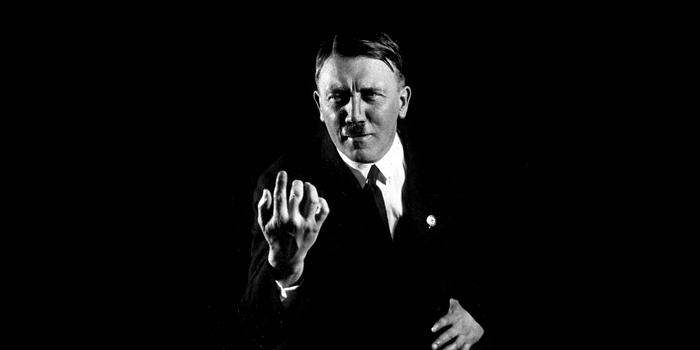
 One of the “rehearsing photos” that Hitler wanted to be destroyed
First, we will take a look at the political circumstances of Hitler‘s time that made his rise to power possible. Then we will assess the crucial events from his personal history and his psychological profile. And finally in chapter 7, we will analyze how a schizophrenic psychopath like him could influence whole nations.
One of the “rehearsing photos” that Hitler wanted to be destroyed
First, we will take a look at the political circumstances of Hitler‘s time that made his rise to power possible. Then we will assess the crucial events from his personal history and his psychological profile. And finally in chapter 7, we will analyze how a schizophrenic psychopath like him could influence whole nations.
1. What were the primary political and economic issues of his time?
Put yourself in the shoes of an average German in 1921. Your country just lost the Great War (WW1), you have to pay reparations to certain countries (roughly equivalent to $442 billion in 2021) and your military is severely restricted. Germany is forced to accept the sole responsibility for all the loss and damage of the war. Your national pride is shattered. You feel humiliated on the international stage. Then in 1929, the Great Depression strikes. The German economy begins to collapse. You cannot feed your family. Everyone around you is suffering. Then comes Adolf Hitler, the leader of the NSDAP party, and promises to restore national pride, take back the land lost in the war, and create more jobs. He has an enchanting charisma and it seems like he can vocalize every feeling of the crowd. He says everything the people want to hear — and then he does exactly what he promises. Everybody loves what he is saying. You believe this visionary leader will take you to a better future.
2. What were the crucial events of his childhood?
4 out of 5 of Hitler’s siblings died, which left a sense of him being exceptional in his mind. At the age of six, his father, Alois Hitler, retired on a pension from the Austrian civil service. He was an alcoholic and a brute and he often beat him. Little Adolf did well in the monastery school and considered becoming a priest. He was always bossy and even when playing with other children, he told them what to do. He is quick to anger and spoiled by his mother, Klara. His father was 22 years older than his mother. The whole family rented a cheap flat, but the mother kept everything shiny clean, as would later note the family’s doctor Eduard Bloch. Hitler’s obsession with cleanliness was fed since the beginning. At the age of 9, he discovered his hidden talent for drawing, especially buildings. He wanted to go to a classical school, but his father insisted on a technical secondary school. Hitler was deeply affected by the death of his younger brother Edmund, who died in 1900 from measles. Hitler changed from a confident, outgoing, conscientious student to a morose and detached boy.
3. Of his adolescence?
Hitler did very poorly in his first year of technical school and became very detached. There were many arguments with his father about his career choice. In Mein Kampf he states that he intentionally did poorly in school, hoping that once his father saw “what little progress I was making at the technical school he would let me devote myself to my dream”. Young Adolf found the idea of spending his life in an office job horrible, whereas his father saw the idea of him becoming an artist ridiculous. In high school, Hitler became interested in history and the idea of Pan-Germanism (unifying all the German-speaking people). His father died in January of 1903, ending their constant battles and allowing him to pursue his dream of becoming an artist. In 1906 he met a new friend, August Kubíček (Kubiczek), who had Czech parents. They shared a passion for the operas of Richard Wagner and became best friends and later roommates in Vienna. Hitler was fascinated with the mythological content of the operas, later using some of the themes in his ideology. Hitler was very close to his mother, so when she developed breast cancer, he didn’t cope very well. The doctor taking care of her was Czech Jew Eduard Bloch. After the war he shared his very interesting notes on the Hitler family:
“While Hitler was not a mother’s boy in the usual sense, I never witnessed a closer attachment. Their love had been mutual. Klara Hitler adored her son. She allowed him his own way whenever possible. For example, she admired his watercolor paintings and drawings and supported his artistic ambitions in opposition to his father at what cost to herself one may guess.”
After Klara Hitler died of breast cancer in 1907, the doctor has another important note:
“I sat with the family for a while, trying to ease their grief. I explained that in this case death had been a savior. They understood. In the practice of my profession it is natural that I should have witnessed many scenes such as this one, yet none of them left me with quite the same impression. In all my career I have never seen anyone so prostrate with grief as Adolf Hitler. “
As the doctor recalls, the mother’s death devastated Hitler, confirming he had an extreme emotional bond to her, unlike anybody else. That points to a strong Oedipal complex, as we will discuss in the psychology section, and to his inability to cope with life’s tragedies. Some critics claim that his mother’s death under the hands of a Jewish doctor triggered Hitler’s antisemitism. The fact that 18 years old Hitler granted the doctor his “everlasting gratitude” for not charging any treatment fees refutes that. In 1908 Hitler even wrote Bloch a postcard assuring him of his gratitude which he expressed with handmade gifts and a large wall painting. Later in 1937, Hitler called him a “noble Jew”.
4. Of his young adulthood?
When his mother died he left Linz to live and study fine art in Vienna, financed by orphan’s benefits. He applied to the Academy of Fine Arts (twice) and was rejected both times. The professors told him he would make a fine architect, not a painter. His friend Kubíček got in. Hitler expected the university will accept him, so the failure demolished his self-esteem and sent him into a downward spiral. He ended up homeless. He focused his hate on the middle-class bourgeoisie, which rejected him and couldn’t understand his “genius”. He probably left Vienna to evade conscription into the Austrian Army, and in 1914 he enlisted into the Bavarian Army. Because of his Austrian citizenship, he had to request permission to serve in the Bavarian army. It was most likely a clerical error because as an Austrian citizen he should not be allowed to join the German ranks.
5. What happened to him during WW1?
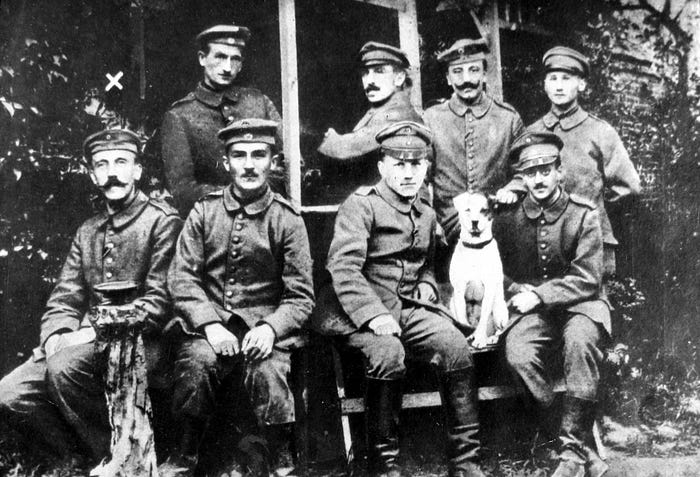 In October 1918, at Werwicq in Belgium, he fell victim to a British gas attack, or so he claimed. He was taken to a Bavarian field hospital at Qudenaarde, unable to see. All the men who had been exposed to gas were treated, but the doctors refused to treat Hitler. They diagnosed him as a “war neurotic” and transported him to the hospital in Pasewalk. His temporal blindness was not from the gas, but a form of “hysterical blindness”.
This incident is one of the key events in Hitler’s early life and could have been a huge factor in shaping Hitler’s future personality. On his hospital admission, Hitler was examined by psychiatrist Dr. Edmund Foster. The diagnosis? A psychopath with hysterical symptoms. During his hospital stay he “miraculously” recovered from the blindness. That convinced him he is the Messiah and his life’s mission was to “save” Germany.
In Mein Kampf, he says that his eyes “turned into glowing coals”. He probably convinced himself he was a victim of the gas attack. Unfortunately, witnesses of the event either committed suicide or disappeared. The event had a deep psychological influence on Hitler. His own “exceptionality” was now confirmed by surviving a deadly attack. Hitler would later cover all his tracks, so he could be politically invincible. On September 11, 1933, Dr. Forster was found dead in his bathroom after an interrogation by the Gestapo.
In October 1918, at Werwicq in Belgium, he fell victim to a British gas attack, or so he claimed. He was taken to a Bavarian field hospital at Qudenaarde, unable to see. All the men who had been exposed to gas were treated, but the doctors refused to treat Hitler. They diagnosed him as a “war neurotic” and transported him to the hospital in Pasewalk. His temporal blindness was not from the gas, but a form of “hysterical blindness”.
This incident is one of the key events in Hitler’s early life and could have been a huge factor in shaping Hitler’s future personality. On his hospital admission, Hitler was examined by psychiatrist Dr. Edmund Foster. The diagnosis? A psychopath with hysterical symptoms. During his hospital stay he “miraculously” recovered from the blindness. That convinced him he is the Messiah and his life’s mission was to “save” Germany.
In Mein Kampf, he says that his eyes “turned into glowing coals”. He probably convinced himself he was a victim of the gas attack. Unfortunately, witnesses of the event either committed suicide or disappeared. The event had a deep psychological influence on Hitler. His own “exceptionality” was now confirmed by surviving a deadly attack. Hitler would later cover all his tracks, so he could be politically invincible. On September 11, 1933, Dr. Forster was found dead in his bathroom after an interrogation by the Gestapo.
5. What was the start of his political career like?
On November 8, 1923, Hitler marched with around 2500 of his supporters through Munich. He planned to seize the city and use it as a base for a march against Germany’s national government. This event would later be called “Beer Hall Putsch”. During the putsch, 16 members of the Nazi group and 4 policemen were killed. The attempt at a coup failed. Hitler fled to the house of his press spokesman, Ernst Hanfstaengl, where he almost committed suicide. Hanfstaengl’s wife Helena stopped him by taking his gun. This behaviour was not unusual. Hitler frequently threatened suicide if events did not go his way. Hitler was later found and arrested on November 11, 1923. He was accused of treason and sentenced to 5 years in Landsberg Prison. Here he would go on and formulate and write Mein Kampf. He was also treated by a psychologist, Alois Maria Ott. During his trial preparation, he constructed a set of arguments for a speech he would later use during the trial — and he succeeded. His speech was printed in the daily journal. In prison, he went on a hunger strike. In 1924 he was treated by a psychologist Alois Maria Ott. Ott shared his experiences after many years when he was 98 years old (more on that in the next section).
6. What was his psychological profile?
Jungian theory
According to Carl Jung, who has also seen one of Hitler’s speeches in person, Hitler was primarily a hysteric. He probably had a sub-form of hysteria — pseudologia phantastica. That means he was a pathological liar who absolutely believed everything he said. That could grant the person possessed by the illness a few productive months of positive public attention. At the same time, it’s also a form of idealism, where the visions are considered to be a noble aim and have to be attained no matter the cost. The possessed believes he is doing everything for the benefit of the whole of humanity and is blind to the fact that his aim is purely egoistic. The psychopathy of such behaviour is not easily recognizable by a layman. But how could such a hysteric psychopath influence whole nations like that? All we have to do is to look at the character of an average German at the moment in time. German people were full of resentment born from their national inferiority complex, fed by the loss of WW1 (by the time referred to as the Great War, as WW2 hasn’t happened yet) and the Versailles treaty consequences. By far the most interesting insight of master Jung is about Hitler’s rise to power. “Suggestion works only when there is a secret wish to fulfill it”, he says. By that, he points to Hitler’s followers and helpers. His words and ideas worked on them because of their inferiority complex and secret dreams of power. As a result, he gathered an army of psychopaths and criminals around him (Goebbels, Goering). At the same time, he grabbed the collective unconscious of normal people, who are always naive and consider themselves “innocent and right”. Jung saw that Hitler’s hysterical mind puts on all of his gesticulations, intent on making an impression. Jung says that the majority of normal people are ridiculously unconscious and naive and are open to any suggestion. That is normal mass psychology. “The more people live together in heaps, the stupider and more suggestible the individual becomes”.
Jung’s Wotan theory
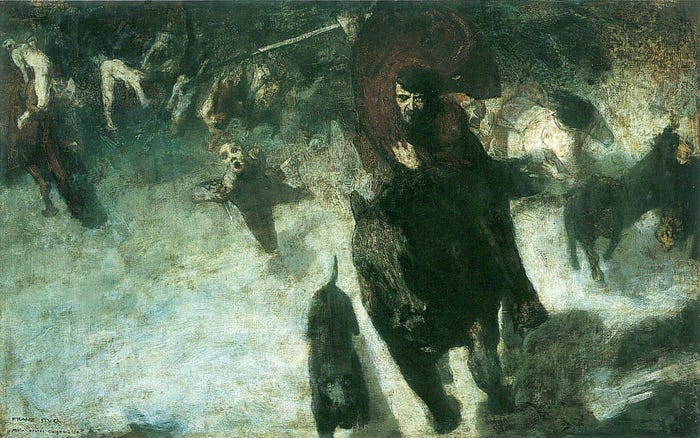 In 1889, the year of Adolf Hitler’s birth, Franz von Stuck painted “The Wild Chase”, depicting Wotan. Look closely.
Another interesting insight is about the Pan-Germanic pagan god Wotan (equivalent to Odin). Jung thought that Hitler and the German nation were possessed by him.
In 1889, the year of Adolf Hitler’s birth, Franz von Stuck painted “The Wild Chase”, depicting Wotan. Look closely.
Another interesting insight is about the Pan-Germanic pagan god Wotan (equivalent to Odin). Jung thought that Hitler and the German nation were possessed by him.
Carl Jung: But what is more than curious — indeed, piquant to a degree — is that an ancient god of storm and frenzy, the long quiescent Wotan, should awake, like an extinct volcano, to new activity, in a civilized country that had long been supposed to have outgrown the Middle Ages. We have seen him come to life in the German Youth Movement, and right at the beginning the blood of several sheep was shed in honour of his resurrection. Armed with rucksack and lute, blond youths, and sometimes girls as well, were to be seen as restless wanderers on every road from the North Cape to Sicily, faithful votaries of the roving god. Later, towards the end of the Weimar Republic, the wandering role was taken over by the thousands of unemployed, who were to be met with everywhere on their aimless journeys. By 1933 they wandered no longer, but marched in their hundreds of thousands. The Hitler movement literally brought the whole of Germany to its feet, from five-year-olds to veterans, and produced the spectacle of a nation migrating from one place to another. Wotan the wanderer was on the move. He could be seen, looking rather shamefaced, in the meeting-house of a sect of simple folk in North Germany, disguised as Christ sitting on a white horse. I do not know if these people were aware of Wotan’s ancient connection with the figures of Christ and Dionysus, but it is not very probable. Perhaps we may sum up this general phenomenon as Ergriffenheit — a state of being seized or possessed. The term postulates not only an Ergriffener (one who is seized) but also an Ergreifer (one who seizes). Wotan is an Ergreifer of men, and, unless one wishes to deify Hitler — which has indeed actually happened — he is really the only explanation. It is true that Wotan shares this quality with his cousin Dionysus, but Dionysus seems to have exercised his influence mainly on women. The maenads were a species of female storm-troopers, and, according to mythical reports, were dangerous enough. Wotan confined himself to the berserkers, who found their vocation as the Blackshirts of mythical kings. With Hitler you do not feel that you are with a man. You are with a medicine man, a form of spiritual vessel, a demi-deity, or even better, a myth. With Hitler you are scared. You know you would never be able to talk to that man; because there is nobody there. He is not a man, but a collective. He is not an individual, but a whole nation. I take it to be literally true that he has no personal friend. How can you talk intimately with a nation? “All these pathological features — complete lack of insight into his own character, auto-erotic self-admiration and self-extentuation, denigration and terrorization of one’s fellow men (how contemptuously Hitler spoke of his own people!), projection of the shadow, lying, falsification of reality, determination to impress by fair means or foul, bluffing and double-crossing — all these were united in the man who was diagnosed clinically as an hysteric, and whom a strange fate chose to be the political, moral, and religious spokesman of Germany for twelve years. Is this pure chance? “
General personality assessment and Neo-Freudian theory
The main hypothesis, according to the DSM-IV Assessment of Adolf Hitler, was that Hitler would have been diagnosed with paranoid schizophrenia today. 5 psychologists got together and retrospectively rated Hitler’s personality on multiple scales. The consensus was that Hitler was very strong on the PTSD scale, had psychotic thinking, schizophrenia, and major depressive disorder. Personality disorders-wise he was paranoid, antisocial, narcissistic, sadistic, and schizoid. According to the study, the borderline scale did not reach clinical significance, but the descriptions from Hitler’s life appear to meet many of the borderline criteria including unstable and intense interpersonal relationships, identity and sexual identity issues, and anger. The borderline criteria also include suicidal gestures. There are 3 known suicidal events — one in the press spokesman’s house after the failed Beer Hall putsch, another in prison, and the third and final in 1945. Finally, all five raters saw him as a strong introvert. This is consistent with the fact that Hitler was socially awkward and often unable to converse with others, and preferred to talk at them. Neo-Freudian psychologist Erich From proposed that Hitler suffered from an Oedipal conflict. He believed he transferred these Oedipal feelings for his mother into allegiance to the German nation and corresponding conflict with “her” prosecutors. Hitler unconsciously wished to kill his rejecting father, and projected this wish into Jewish Marxist intellectuals, and by association, all other Jews.
Hitler‘s psychologist diagnosis
While in Landsberg prison in 1924, Hitler was rehabilitated by a prison psychologist, Alois Maria Ott. He disclosed his experiences with Hitler at the age of 98. On arrival at the prison, Hitler was “of moderate strength,” 5 feet 9 inches tall, and weighed 76 kilograms. In this examination, it was also found that Hitler had “right-side cryptorchidism” or an undescended right testicle. This rumor was thus confirmed in 2015 thanks to the prison report. Hitler would either remain silent, “acted fresh, or broke out into crying fits.” His shouts and screams could be heard all over the building. After a few sessions with Hitler, Ott made his assessment of the prisoner: a hysteric and pathological psychopath.
7. How could Hitler influence whole nations to such an extent?
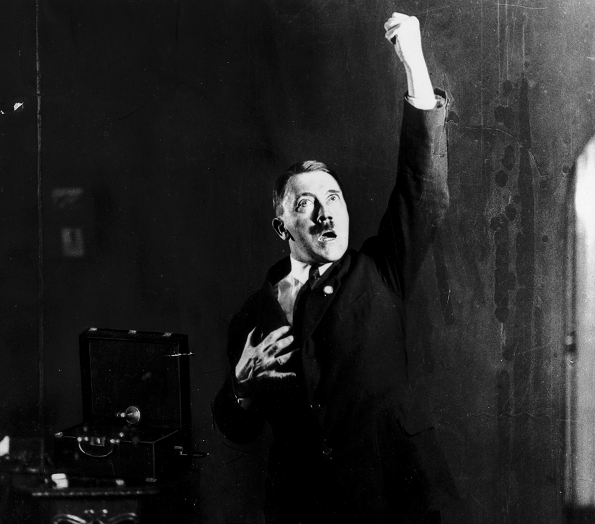 Another of the “rehearsing photos”
The whole nation of Germany was feeling depressed and then the financial crisis came. Jung argues that the climate of Germans was almost that of a “psychological inferiority”. Hitler simply embodied the feeling of the majority of people.
An interesting insight comes from the book “Ordinary men”, which is about a squad of Nazi executioners in the concentration camps. It would be simple to explain their behaviour as driven by fear of punishment if they don’t do their job (that is, executing camp prisoners). But as comes to light from the book, there were almost no consequences if they didn’t obey orders.
They were not forced at all but were told that they can leave whenever they want without any consequences. At first, the executioners had tremendous difficulties with carrying out the executions (symptoms like vomiting after the act and psychological trauma). Eventually, they adapted and started having no difficulties with executing Jew prisoners.
The book “Hitler’s willing executioners” goes to greater lengths describing this squad of soldiers. The soldiers executed Jew prisoners in greater numbers than others. That points to the hypothesis that the members of the working-class (the executioners were “normal” people, construction workers before the war, etc.) had inherent hate towards Jews and the antisemitism was not a symptom of Hitler’s propaganda but was already inside the general public. Hitler came and only awoken it from the collective unconscious of the German public.
Another of the “rehearsing photos”
The whole nation of Germany was feeling depressed and then the financial crisis came. Jung argues that the climate of Germans was almost that of a “psychological inferiority”. Hitler simply embodied the feeling of the majority of people.
An interesting insight comes from the book “Ordinary men”, which is about a squad of Nazi executioners in the concentration camps. It would be simple to explain their behaviour as driven by fear of punishment if they don’t do their job (that is, executing camp prisoners). But as comes to light from the book, there were almost no consequences if they didn’t obey orders.
They were not forced at all but were told that they can leave whenever they want without any consequences. At first, the executioners had tremendous difficulties with carrying out the executions (symptoms like vomiting after the act and psychological trauma). Eventually, they adapted and started having no difficulties with executing Jew prisoners.
The book “Hitler’s willing executioners” goes to greater lengths describing this squad of soldiers. The soldiers executed Jew prisoners in greater numbers than others. That points to the hypothesis that the members of the working-class (the executioners were “normal” people, construction workers before the war, etc.) had inherent hate towards Jews and the antisemitism was not a symptom of Hitler’s propaganda but was already inside the general public. Hitler came and only awoken it from the collective unconscious of the German public.
Carl Jung: Now, the secret of Hitler’s power is not that Hitler has an unconscious more plentifully stored than yours or mine. Hitler’s secret is twofold: first, that his unconscious has exceptional access to his consciousness, and second, that he allows himself to be , moved by it. He is like a man who listens intently to a stream of suggestions in a whispered voice from a mysterious source and then acts upon them. In our case, even if occasionally our unconscious does reach us as through dreams, we have too much rationality, too much cerebrum to obey it. This is doubtless the case with Chamberlain, but Hitler listens and obeys. The true leader is always led. We can see it work in him. He himself has referred to his Voice. His Voice is nothing other than his own unconscious, into which the German people have projected their own selves; that is, the unconscious of seventy-eight million Germans. That is what makes him powerful.
8. Other interesting facts about Hitler to conclude
His father was very dominant and his mother very submissive. He mirrored this in his sexual relationships. His girlfriends were always naive, childish, and submissive. This points to his under-developed Anima and her projection into real women. All his girlfriends either tried or succeeded at committing suicide, either to gain his attention or from realizing what kind of man he is. Including Eva Braun, who tried to commit suicide after he didn’t pay enough attention to her. He was vegetarian and loved animals, especially dogs. He didn’t drink any alcohol, probably because his father was an alcoholic and he hated him. He often worked late into the night, like a nighttime artist. He was extremely obsessed with cleanliness and was a mysophobe (fear of filth). He bathed multiple times a day. His extremely elevated disgust sensitivity also explains why he often referred to Jews as a virus, infection, and cancer. He saw Germany as “One body” and Jews as a virus or cancer that was destroying it. He often openly refers to Jews as viruses and infection in his public speeches.