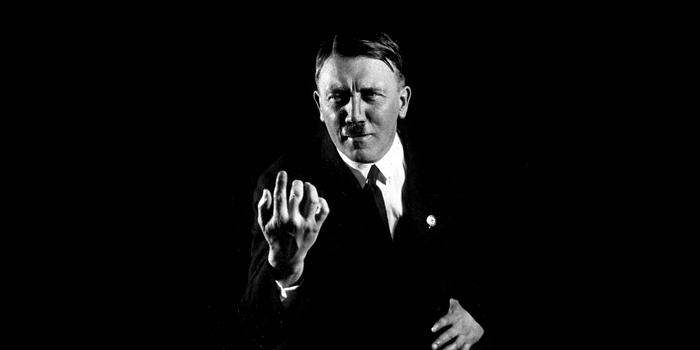
 One of the “rehearsing photos” that Hitler wanted to be destroyed
First, we will take a look at the political circumstances of Hitler‘s time that made his rise to power possible. Then we will assess the crucial events from his personal history and his psychological profile. And finally in chapter 7, we will analyze how a schizophrenic psychopath like him could influence whole nations.
One of the “rehearsing photos” that Hitler wanted to be destroyed
First, we will take a look at the political circumstances of Hitler‘s time that made his rise to power possible. Then we will assess the crucial events from his personal history and his psychological profile. And finally in chapter 7, we will analyze how a schizophrenic psychopath like him could influence whole nations.
1. What were the primary political and economic issues of his time?
Put yourself in the shoes of an average German in 1921. Your country just lost the Great War (WW1), you have to pay reparations to certain countries (roughly equivalent to $442 billion in 2021) and your military is severely restricted. Germany is forced to accept the sole responsibility for all the loss and damage of the war. Your national pride is shattered. You feel humiliated on the international stage.
Then in 1929, the Great Depression strikes. The German economy begins to collapse. You cannot feed your family. Everyone around you is suffering. Then comes Adolf Hitler, the leader of the NSDAP party, and promises to restore national pride, take back the land lost in the war, and create more jobs. He has an enchanting charisma and it seems like he can vocalize every feeling of the crowd. He says everything the people want to hear — and then he does exactly what he promises. Everybody loves what he is saying. You believe this visionary leader will take you to a better future.
2. What were the crucial events of his childhood?
4 out of 5 of Hitler’s siblings died, which left a sense of him being exceptional in his mind. At the age of six, his father, Alois Hitler, retired on a pension from the Austrian civil service. He was an alcoholic and a brute and he often beat him. Little Adolf did well in the monastery school and considered becoming a priest. He was always bossy and even when playing with other children, he told them what to do. He is quick to anger and spoiled by his mother, Klara.
His father was 22 years older than his mother. The whole family rented a cheap flat, but the mother kept everything shiny clean, as would later note the family’s doctor Eduard Bloch. Hitler’s obsession with cleanliness was fed since the beginning.
At the age of 9, he discovered his hidden talent for drawing, especially buildings. He wanted to go to a classical school, but his father insisted on a technical secondary school.
Hitler was deeply affected by the death of his younger brother Edmund, who died in 1900 from measles. Hitler changed from a confident, outgoing, conscientious student to a morose and detached boy.
3. Of his adolescence?
Hitler did very poorly in his first year of technical school and became very detached. There were many arguments with his father about his career choice. In Mein Kampf he states that he intentionally did poorly in school, hoping that once his father saw “what little progress I was making at the technical school he would let me devote myself to my dream”. Young Adolf found the idea of spending his life in an office job horrible, whereas his father saw the idea of him becoming an artist ridiculous.
In high school, Hitler became interested in history and the idea of Pan-Germanism (unifying all the German-speaking people). His father died in January of 1903, ending their constant battles and allowing him to pursue his dream of becoming an artist.
In 1906 he met a new friend, August Kubíček (Kubiczek), who had Czech parents. They shared a passion for the operas of Richard Wagner and became best friends and later roommates in Vienna. Hitler was fascinated with the mythological content of the operas, later using some of the themes in his ideology.
Hitler was very close to his mother, so when she developed breast cancer, he didn’t cope very well. The doctor taking care of her was Czech Jew Eduard Bloch. After the war he shared his very interesting notes on the Hitler family:
“While Hitler was not a mother’s boy in the usual sense, I never witnessed a closer attachment. Their love had been mutual. Klara Hitler adored her son. She allowed him his own way whenever possible. For example, she admired his watercolor paintings and drawings and supported his artistic ambitions in opposition to his father at what cost to herself one may guess.”



 The basic law of the Universe is that of karma. Everything you do leaves a debt, be it good or bad.
I use this philosophy for my everyday life. I know that when I will partake in hedonistic pleasures, it will incur a debt, I will have to pay for later.
So, when I have a day that is full of easy things, then I know the second day will be full of difficult things. Thus I try to do very difficult things, so I can have an easy time later.
The same goes for any kind of project. Be it your college project or a work project. When I go for the easy way out, and I make some short-sighted decision, it ALWAYS comes back, sooner or later, and kicks me in the butt.
I can’t say how many times I used a “hacky” solution in a programming project, only for it to bring bugs or other implementation difficulties later on.
Thus, I now I try to go for long-term decisions, that are often hard to make and implement but are the only right thing to do, compared to short-term solutions that will need a rework later.
This concept even has a name in programming - it’s called “
The basic law of the Universe is that of karma. Everything you do leaves a debt, be it good or bad.
I use this philosophy for my everyday life. I know that when I will partake in hedonistic pleasures, it will incur a debt, I will have to pay for later.
So, when I have a day that is full of easy things, then I know the second day will be full of difficult things. Thus I try to do very difficult things, so I can have an easy time later.
The same goes for any kind of project. Be it your college project or a work project. When I go for the easy way out, and I make some short-sighted decision, it ALWAYS comes back, sooner or later, and kicks me in the butt.
I can’t say how many times I used a “hacky” solution in a programming project, only for it to bring bugs or other implementation difficulties later on.
Thus, I now I try to go for long-term decisions, that are often hard to make and implement but are the only right thing to do, compared to short-term solutions that will need a rework later.
This concept even has a name in programming - it’s called “