What, if some day or night a demon were to steal after you into your loneliest loneliness and say to you: ‘This life as you now live it and have lived it, you will have to live once more and innumerable times more’ … Would you not throw yourself down and gnash your teeth and curse the demon who spoke thus? Or have you once experienced a tremendous moment when you would have answered him: ‘You are a god and never have I heard anything more divine.’
11 min read · Feb 10, 2019 13 1 Nietzsche’s idea of eternal recurrence came to him in August 1881, and after that he made it one of the fundamental concepts of his next book Thus spoke Zarathustra.
But what is the evidence of this idea being true?
Let’s take a look into ancient mythology first, namely the Babylonian creation myth, Enûma Eliš (1900 BCE). It consists of 7 tablets and it contains numerous parallels with the Old Testament (watery chaos before creation; 7 days of creation; separation of the chaos into heaven and earth).
The story begins before the advent of anything, when only the primordial entities Apsu and Tiamat existed co-mingled together. Tiamat is the primordial goddess of the salt sea, the symbol of chaos of primordial creation. Apsu is the primordial being made of sweet fresh water, the opposite of Tiamat. He is the male aspect of the two.
If we draw from comparative mythology and look into Chinese dualistic cosmology, where the origin myth is also based on two fundamental concepts of chaos and order, we find yin and yang. Those are mainly discussed in Taoism and Confucianism. If we quickly diverge into neurology, we can also see that the right brain hemisphere is responsible for handling the unknown, chaos; the left hemisphere is responsible for keeping order. The brain itself developed to be able to interpret the dualistic reality of the eternal battle between chaos and order.
Now, the formless and invisible chaos is represented by snakes. They also represent desires, suffering and death. As those who are bitten by snakes are vulnerable to suffering and death and those who are controlled by their desires must suffer the cycle of births and deaths — if you don’t control your desires, you will be bound to reincarnation by your karma.
If you cut of the head of the snake with lightning — that is the action where something is created out of the formless — the unknown becomes known (in modern interpretations we can see this in the last Harry Potter — the last horcrux of the agent of chaos, Voldemort, is a snake and its head is cut off. Harry Potter himself represents Saint George. J.K. Rowling really did her reading.)
Vritra was an absolute ruler of the whole of primordial Chaos, same as Tiamat or any snake-like deity. Vritra is in Vedic religion represented as a serpent or dragon; Indra is the guardian deity in Buddhism, and the king of the highest heaven. His powers are the same as in other Indo-European deities such as Jupiter, Zeus, Perun, Thor and Odin. Vritra is the god of the heavens, lightning, thunder, storms, rains and river flows (as is Zeus, Thor and the other named). Vritra is a dragon blocking the course of the rivers and is slain by Indra.
See the resemblance? Marduk is the same as all of these. The god of storm, the highest of the gods. Creator of order out of chaos. Killer of the chaos entity, snake goddess Tiamat.
In Nordic mythology, there is a snake at the base of Yggdrasil, and it’s eating its own tail. Once it stops biting its tail and eating itself, Ragnarok will start. And then Thor has to kill the snake. The manifestation of chaos. Same as Marduk did with Tiamat.
To prepare for battle, he makes a bow, fletches arrows, grabs a mace, throws lightning before him, fills his body with flame, makes a net to encircle Tiamat within it, gathers the four winds so that no part of her could escape, creates seven nasty new winds such as the whirlwind and tornado, and raises up his mightiest weapon, the rain-flood. Then he sets out for battle, mounting his storm-chariot drawn by four horses with poison in their mouths. In his lips he holds a spell and in one hand he grasps a herb to counter poison.
First, he challenges the dragon of the primordial sea Tiamat to single combat and defeats her by trapping her with his net, blowing her up with his winds, and piercing her belly with an arrow.
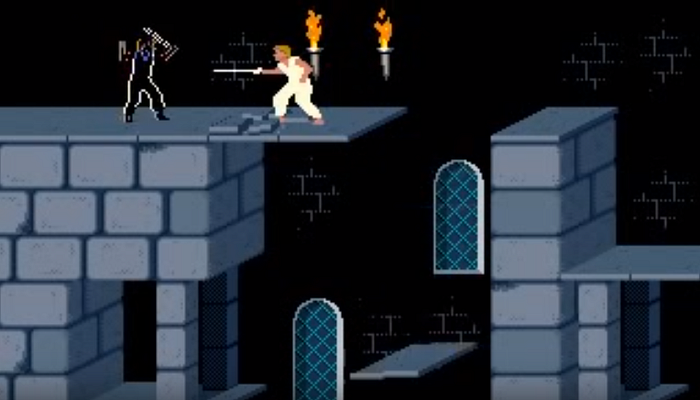 Facing your shadow. You win only if you don’t fight it. Prince of persia (1989)
You can see the concept most easily in the movie Fight Club (1999). Materialistic capitalistic man is not capable to attain his higher ideals (if he even has any), so he develops an alter ego — except the “person” was in him all along. He just suppressed that part of himself for so long that it had to get out in some way. Tyler Durden is created. Only after a long struggle the main hero “comes to terms” (well, kind of) with his Shadow side and integrates it. Only then he becomes his true individual Self (with a hole in his cheek — that symbolism shows you that you cannot “just integrate” your Shadow without sacrificing a piece of yourself).
Facing your shadow. You win only if you don’t fight it. Prince of persia (1989)
You can see the concept most easily in the movie Fight Club (1999). Materialistic capitalistic man is not capable to attain his higher ideals (if he even has any), so he develops an alter ego — except the “person” was in him all along. He just suppressed that part of himself for so long that it had to get out in some way. Tyler Durden is created. Only after a long struggle the main hero “comes to terms” (well, kind of) with his Shadow side and integrates it. Only then he becomes his true individual Self (with a hole in his cheek — that symbolism shows you that you cannot “just integrate” your Shadow without sacrificing a piece of yourself).
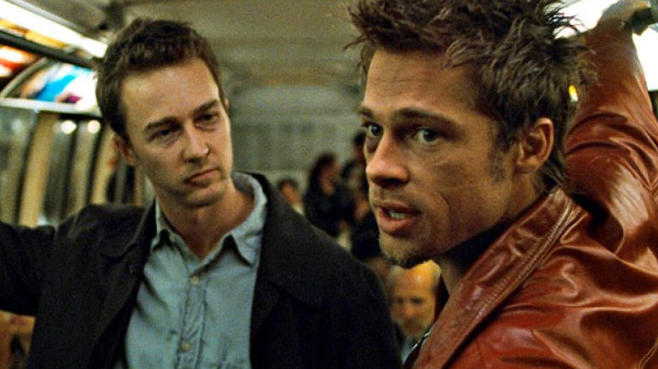 Fight Club (1999)
The Dark Knight (2008) — an absolute classic. The manifestation of chaos, the “Joker” (who is also a very clearly the “Joker” archetype…) faces his polar opposite, Batman. Batman is so called “superego”, Bruce Wayne is “ego” and Joker is the “Shadow”. Bruce Wayne aims to be his ideal Self, the Batman; at the same time, Joker has very interesting ideas that Bruce has to accept in himself in order to become his fully authentic Self. The conversation between them is a honorable compliment to Heat (1995), where a very similar conversation takes place (chaos vs order — in the middle is Tao, the Way to be; the silver lining; state of harmony and individual Being).
Fight Club (1999)
The Dark Knight (2008) — an absolute classic. The manifestation of chaos, the “Joker” (who is also a very clearly the “Joker” archetype…) faces his polar opposite, Batman. Batman is so called “superego”, Bruce Wayne is “ego” and Joker is the “Shadow”. Bruce Wayne aims to be his ideal Self, the Batman; at the same time, Joker has very interesting ideas that Bruce has to accept in himself in order to become his fully authentic Self. The conversation between them is a honorable compliment to Heat (1995), where a very similar conversation takes place (chaos vs order — in the middle is Tao, the Way to be; the silver lining; state of harmony and individual Being).
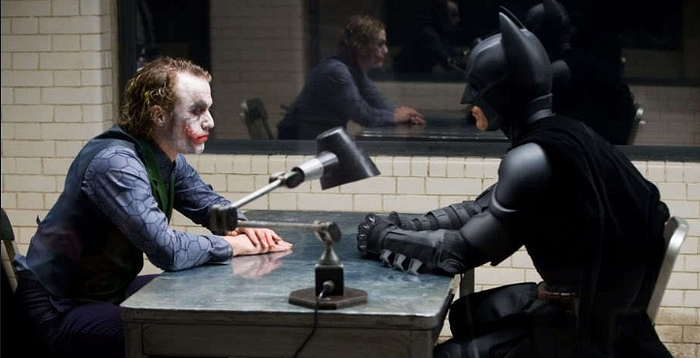 Heath Ledger got so immersed into the chaos/Joker/Shadow, that he got lost in the Abyss.
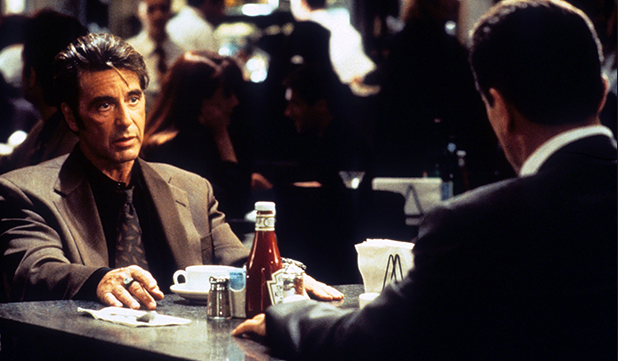 Heat (1995) — Al Pacino vs De Niro. Order vs Chaos. I believe that the ketchup bottle got sold in an auction afterwards.
Another classic “Shadow integration”, (SPOILER ahead!) or perhaps multiple-personality movie, is Who Am I — No System is Safe (2014). It is about a computer hacker with a similar aim as Tyler Durden.
Heat (1995) — Al Pacino vs De Niro. Order vs Chaos. I believe that the ketchup bottle got sold in an auction afterwards.
Another classic “Shadow integration”, (SPOILER ahead!) or perhaps multiple-personality movie, is Who Am I — No System is Safe (2014). It is about a computer hacker with a similar aim as Tyler Durden.
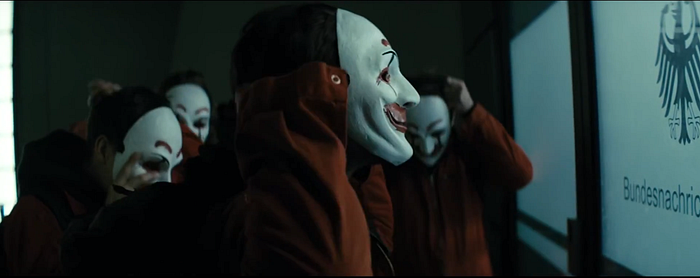 Who Am I, ready to break into German “NSA”