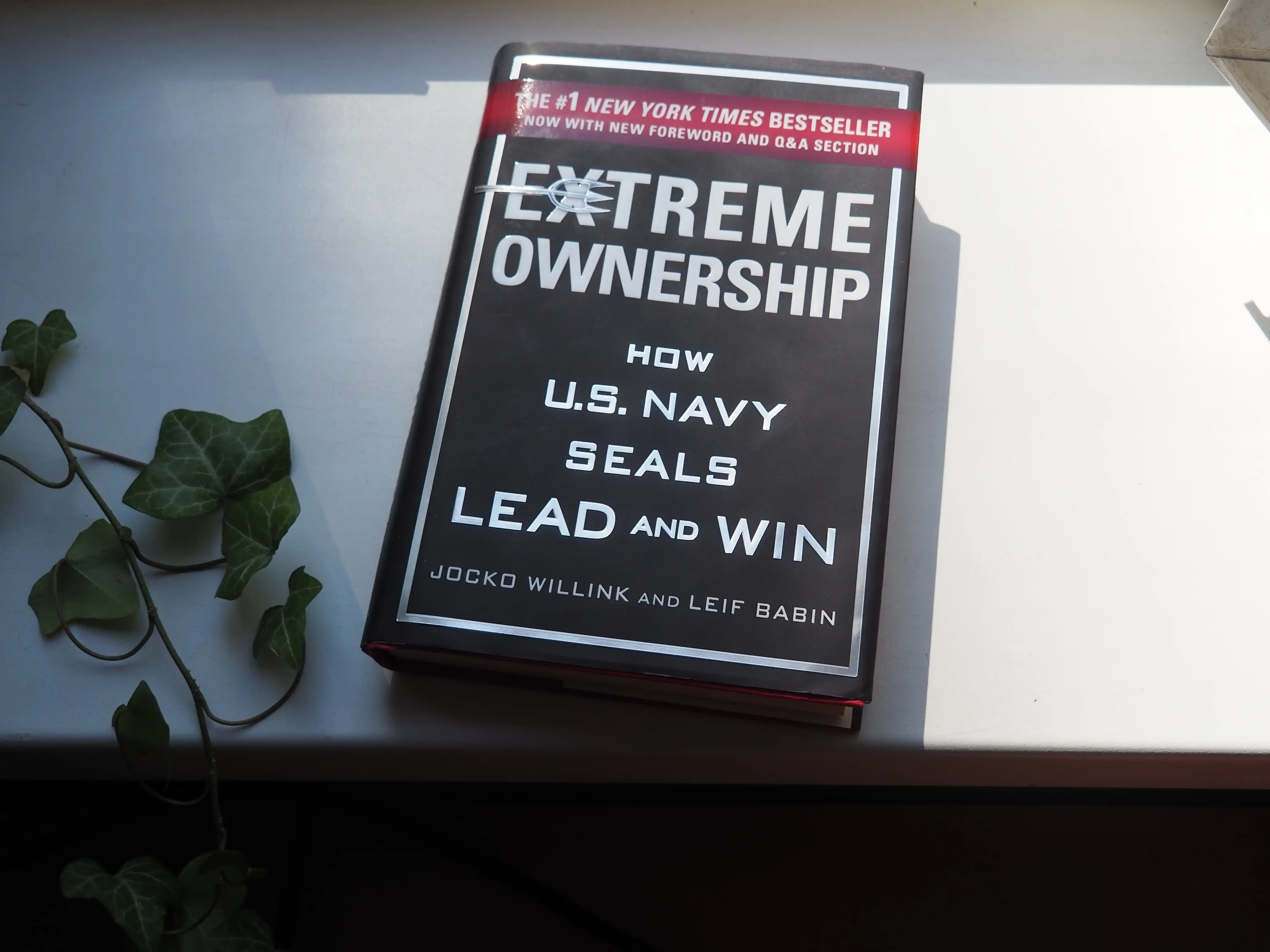
This is a collection of the quotes I saved while reading the Extreme ownership by Jocko Willink, in 2024-2025 to help me to be a better tech lead in our gamedev firm.
- A003: “I discovered that it was far more effective to focus their efforts not on the days to come or the far-distant finish line they couldn’t yet see, but instead on a physical goal immediately in front of them—the beach marker, landmark, or road sign a hundred yards ahead. If we could execute with a monumental effort just to reach an immediate goal that everyone could see, we could then continue to the next visually attainable goal and then the next.”
- A004: “as a leader, it’s not what you preach, it’s what you tolerate. When setting expectations, no matter what has been said or written, if substandard performance is accepted and no one is held accountable—if there are no consequences—that poor performance becomes the new standard. Therefore, leaders must enforce standards. Consequences for failing need not be immediately severe, but leaders must ensure that tasks are repeated until the higher expected standard is achieved. Leaders must push the standards in a way that encourages and enables the team to utilize Extreme Ownership.”
- A005: “We had used Cover and Move within my own immediate OP2 team, but I had forgotten about the greater team and support available. We had operated independently, failing to support or help each other.”
- A006: “We were all trying to accomplish the same mission.”
- A007: “Departments and groups within the team must break down silos, depend on each other and understand who depends on them. If they forsake this principle and operate independently or work against each other, the results can be catastrophic to the overall team’s performance.”
- A009: “It falls on leaders to continually keep perspective on the strategic mission and remind the team that they are part of the greater team and the strategic mission is paramount.”
- A010: ““Engage with them,” directed Jocko. “Build a personal relationship with them. Explain to them what you need from them and why, and ask them what you can do to help them get you what you need.””
- A011: “…if he wasn’t working together with this subsidiary company, then he was failing his team.”
- B016: “They were operating with limited resources and limited manpower.”
- B017: “…we need to simplify this a little bit.”
- B018: “OPORD” (Handwritten note: Operations Order—Kick-off sounds good)
- B001: “Combat, like anything in life, has inherent layers of complexities. Simplifying as much as possible is crucial to success. When plans and orders are too complicated, people may not understand them.”
- B002: “Everyone in the team must understand what to do in the event of likely contingencies.”
- D0008: complex plans add to confusion, which can compound into disaster. Almost no mission ever goes according to plan. There are simply too many variables to deal with. This is where simplicity is key.
- B037: “Prioritize and Execute: Even the greatest battlefield leaders could be overwhelmed if they tried to tackle everything at once.”
- A016: “Relax, look around, make a call.”
- D0006: don’t let the focus on one priority cause target fixation.
- D0007: With my leaders running their teams and handling the tactical decisions, it made my job much easier by enabling me to focus on the bigger picture.
- C001: “With all that you have planned, do you think your team is clear that this is your highest priority?”
- C002: “Smaller teams: allow them to execute based on a good understanding of the broader mission (known as Commander’s Intent), and standard operating procedures.”
- C003: SEAL leaders on the battlefield are expected to figure out what needs to be doen and do it - to tellhigher authority what they plan to do, rather thank ask. “What do you want me to do?” Junior leaders must be proactive rather than reactive.
- C004: “Senior leaders must constantly communicate and push information—what we call in the military ‘situational awareness’”
- C005: “Team must be broken down into manageable elements of four to five operators, with a clearly designated leader.”
- C006: “Contrary to a common misconception, leaders are not stuck in any particular position. Leaders must be free to move to where they are most needed, which changes throughout the course of an operation.”
- C007: “four-to-six-man teams with a leader. We call them ‘fire teams.’ That is the ideal number for a leader to lead.”
- C008: “That was what mission planning was all about: never taking anything for granted, preparing for likely contingencies, and maximizing the chance of mission success while minimizing the risk to the troops executing the operation.”
- C009: “those who will not risk cannot win”
- C010: “By maintaining a perspective above the microterrain of the plan, the senior leader can better ensure compliance with strategic objectives. This enables senior leaders to ‘step back and be the tactical genius’”
- C44: The planning process and briefing must be a forum that encourages discussion, questions, and clarification from even the most junior personnel. If frontline troops are unclear about the plan and yet are too intimidated to ask questions, the team’s ability to effectively execute the plan radically decreases.”
- C045: “after each combat operation, conduct what we call a ‘post-operational debrief.’ No matter how exhausted from an operation or how busy planning for the next mission, time is made for this debrief because lives and future mission success depend on it. A post-operational debrief examines all phases of an operation from planning through execution, in a concise format. “What went right? What went wrong?” “How can we adapt our tactics to make us even more effective and increase our advantage over the enemy?”
- C013: “Leaders must delegate the planning process down the chain as much as possible to key junior leaders.”
- C015: “You can then see the plan from a greater distance, a higher altitude, and you will see more. This enables you to look like a tactical genius, just becase you have a broader view”
- D0005: “Here is what I want you to do: forget about all this crazy PowerPoint. I want this plan to be clear to everyone that is actually in your platoon. I’m not worried about the CO or the master chief. Brief it to your guys: the troops who will be executing the mission.” You need to brief so that the most junior man can fully understand the operation—the lowest common denominator.
- D0003: A leader’s checklist for planning should include the following:
- Analyze the mission.
- Understand higher headquarters’ mission, Commander’s Intent, and endstate (the goal).
- Identify and state your own Commander’s Intent and endstate for the specific mission.
- Identify personnel, assets, resources, and time available.
- Decentralize the planning process.
- Empower key leaders within the team to analyze possible courses of action.
- Determine a specific course of action.
- Lean toward selecting the simplest course of action.
- Focus efforts on the best course of action.
- Empower key leaders to develop the plan for the selected course of action.
- Plan for likely contingencies through each phase of the operation.
- Mitigate risks that can be controlled as much as possible.
- Delegate portions of the plan and brief to key junior leaders. —Stand back and be the tactical genius.
- Analyze the mission.
- C018: “I should have given greater ownership of plans to the troops - especially those who were negative and werent’t fully commited to the mission… I should have taken the time to better understand how what we were doing contributed to the strategic mission.”
- C021: “leading down the chain of command”
- D0004: Yet, if I didn’t fully comprehend or appreciate the strategic impact of what we had done, how could I expect my frontline troops—my junior SEAL operators not in a leadership role—to get it? The answer: I couldn’t. For a young SEAL shooter with a very limited role in the planning process who was out working on his weapons and gear, conducting maintenance on our vehicles, or building demolition charges for the breacher, he walked into our mission briefs wondering: What are we doing next? He had no context for why we were doing the operation or how the next tactical mission fit into the bigger picture of stabilizing and securing Ramadi.
- D0002: Jocko continued: “But all of these operations need the CO’s approval. He has to be comfortable with what we are doing. And we need his support to get additional approvals from higher up the chain. So we can complain about this all day and do nothing, or we can push the necessary information up the chain so that the CO is comfortable and gives us approval.”
- C020: “We have to own everything in our world. That’s what Extreme Ownership is all about.”
- C023: “my default setting should be aggressive—proactive rather than reactive.”
- C024: “A public display of discontent or disagreement with the chain of command undermines the authority of leaders at all levels. This is catastrophic to the performance of any organization.”
- C022: “look in the mirror first and determine what you can do to better enable this. Don’t ask your leader what you should do, tell them what you are going to do.”
- D0001: “How do you want to be perceived?” I asked Darla. “Do you want to be seen as someone who can be held hostage by the demands—the threats—they are making? Do you want to be seen as indecisive?”
- C025: “As a leader, you want to be seen—you need to be seen—as decisive, and willing to make tough choices.”
- C026: “But discipline is paramount to ultimate success and victory for any leader and any team.”
- C027: “We standardized the way we loaded vehicles. We standardized the way we mustered in a building on a target. We standardized the way we ‘broke out’ (or exited) from buildings. There was a disciplined methodology to just about everything we did.” - Unit tests, APIs
- C031: “Perhaps the junior person has greater experties in a particular area or more experience. Perhaps he or she simply thought of a better way to accomplish the mission.”
- C032: “Leaders must be humble but not passive; quiet but not silent. They must possess humility and the ability to control their ego and listen to others. They must admit mistakes and failures, take ownership of them, and figure out a way to prevent them from happening again. But a leader must be able to speak up when it matters. They must be able to stand up for the team and respectfully push back against a decision, order, or direction that could negatively impact overall mission success.”
- C033: “Leaders who lose their temper also lose respect.”
- C034: A good leader must be:
- Confident but not cocky.
- Courageous but not foolhardy.
- Competitive but a gracious loser.
- Attentive to details but not obsessed by them.
- Strong but have endurance.
- A leader and follower.
- Humble but not passive.
- Aggressive but not overbearing.
- Quiet but not silent.
- Calm but not robotic; logical but not devoid of emotions.
- Close with the troops but not so close that one becomes more important than another or more important than the good of the team; not so close that they forget who is in charge.
- Able to execute Extreme Ownership, while exercising Decentralized Command.